


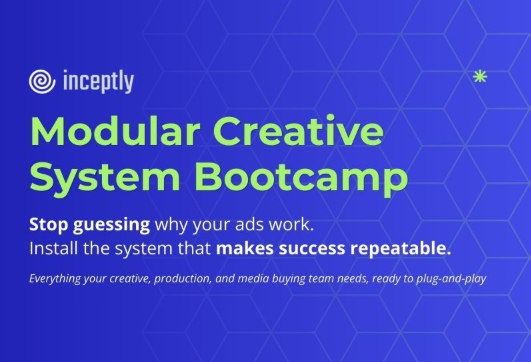
Inceptly – Modular Creative Bootcamp
| Original Sale Price: | $ 197 |
| Delivery: | |
| Size: | 2.77 GB |
| Files: | View Files |
| Sale Page: | Link |
| Archive: | Link |
If you want to be able to watch the course or download it you have to be our paid member.
Please, go here and choose your membership.
If you have 3 or more products in the cart, you may see an option to buy Lifetime Membership for only $69 during checkout.
Here’s What You Get:
This is for you if:
- You’re spending on paid ads and know you need more creative volume to find winners
- You’ve tested ads before but can’t tell why the winners won or the losers lost
- You have an editor (or can hire one) to implement the production system
- You want to build in-house capability — not depend on an agency forever
- You’re willing to actually implement, not just watch lessons
Module 1: The Modular Creative System
Lesson 1 — Why Modular: The Big Picture
How the shift to Demand Gen changed the bottleneck from ad spend to creative volume — and why the old “hook + core” approach can’t keep up. The 3-segment structure (Intro, Bridge, Core) and the combination math that turns 17 components into 100+ ads.
Lesson 2 — Reading Ads Through the Modular Lens
Watch Inceptly’s Creative Director analyze real ads across supplements, real estate, women’s wellness, and business financing — identifying exactly where the modular system would multiply their output and what they’re leaving on the table.
Module 2: The Scripting System
Lesson 3 — Intros: Psychology + Execution
The two-layer intro taxonomy that produces 30 distinct opening combinations from a single framework. Layer 1: the five psychological reasons someone gives you their attention. Layer 2: the six execution formats that earn the next second. Most systems mix these together. We separate them so you can scale and diagnose.
Lesson 4 — Bridges & Cores
Six bridge types that each create a different belief shift — reframe, mechanism, permission, contrast, proof, and gradualization. Two core pathways: Logic Lock (rational) and Identity Close (emotional), each following a 5-block structure. Together, they give your ad the strategic middle that most brands skip.
Lesson 5 — Building a Script Set: Live Walkthrough
Watch the full system in action: 10 intros, 5 bridges, and 2 cores built live for four real brands. See how existing ads get reverse-engineered into modular components, how compliance considerations get woven into supplement scripts, and how different niches use the same taxonomy to produce completely different creative.
Lesson 6 — Your AI Script Factory
Set up a permanent AI scriptwriting partner in under 70 minutes. Upload your niche template, paste your product brief, and start generating scripts on demand — no re-explaining, no re-uploading, no wasted context window. Works with Claude Projects and ChatGPT Projects. Includes tested prompts for every component type, a labeling system that feeds directly into your media buying tracking, and iteration prompts that turn performance data into better scripts.
Module 3: Production & Editing
Lesson 7 — Visual Formats & AI Production
Seven hook format types (pattern interrupt, AI podcast, AI UGC, street interview, text-on-screen, split screen, motion graphics) with the exact Gemini → Photoshop → Veo 3 workflow Inceptly uses to produce them. When to use AI vs. real presenters. Caption safe zones for YouTube and Shorts. Platform compliance for YouTube and Meta — including how to produce health and transformation creative that doesn’t get flagged.
Lesson 8 — Batch Rendering & Assembly
How to organize your component files, run them through concatenation software, add music, convert aspect ratios, and export 100+ platform-ready ads overnight. The naming conventions that make every rendered file traceable back to its component parts.
Module 4: Testing, Tracking & Scaling
Lesson 9 — The Testing Framework
Inceptly’s Director of Media Buying shares the philosophy behind $250M+ in managed ad spend: “Performance comes from building a learning system, not an ad machine.” The Plan → Do → Check → Action cycle. Why 7-day testing cycles. How to define a hypothesis before you touch Google Ads.
Lesson 10 — Campaign Setup & Naming Conventions
Specific Demand Gen campaign settings: $200/day budget minimums, why Maximize Conversions beats Target CPA for new creative, why open targeting outperforms interest groups, and the naming convention system that makes component-level tracking possible. Plus: how to set up Looker Studio to answer “which intros are winning?” at a glance.
Lesson 11 — Scaling, Review & The Learning Loop
How to read view rates, CTR, and conversion rates to diagnose exactly which components are working and which are failing. The kill/scale decision framework ($150 in spend with no conversion = kill). How Demand Gen and PMax complement each other. And how each testing cycle feeds learnings back into your next round of creative — the compounding loop that makes this system get better over time.
Related products
Free For Members
Free For Members
Free For Members

Free For Members

Free For Members
Free For Members

Free For Members
Free For Members